
American Insulated Sandwich Panels: Cost, Thickness, and Material Types
In the United States, insulated sandwich panels are widely used in industrial and residential buildings due to their high energy efficiency and ease of installation. Choosing the right sandwich panel requires considering key factors such as cost, thickness, and material type, as these directly affect its performance and durability.
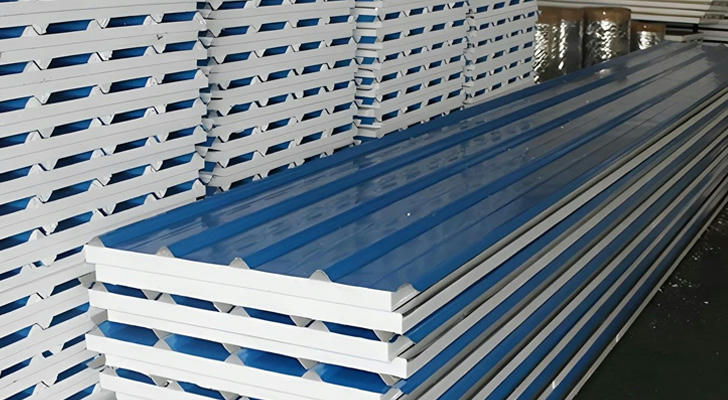
In industrial and commercial projects, sandwich panels can simultaneously meet two requirements: a well-airtight building envelope and excellent thermal insulation (and sometimes sound insulation) performance. It is a prefabricated system. However, its performance can vary significantly depending on the insulation core material, thickness, panel type, and installation details.
What Is an Insulated Sandwich Panel?
An insulated sandwich panel is a construction component made up of:
Two rigid facings (most commonly steel sheets)
An insulating core in the center
It is manufactured in large-format panels and fixed to steel or concrete structures to form walls or roofs.
The core limits heat transfer and, depending on the material used, can provide different levels of fire performance and acoustic insulation.
In practice, this system stands out for:
Fast installation compared with traditional “wet” construction methods (masonry, mortar, plaster)
Reliable, predictable performance when the design is properly specified, particularly for:
Joints
Finishing elements
Fasteners
Sealing systems
Vapor barriers
Final performance depends not only on the panel itself, but also on how joints and thermal bridges are detailed and treated.
Materials and Thicknesses: Performance and Benefits
The first selection criterion is the type of insulating core. In the United States, the most commonly used options are:
PUR (polyurethane)
PIR (polyisocyanurate)
Mineral wool (rock wool)
General Comparison of Core Materials
PUR / PIR
Excellent thermal insulation with moderate thicknesses
PIR generally offers better fire performance and higher temperature resistance
Mineral wool
Preferred when higher fire-resistance requirements apply
Better acoustic performance
Common Thicknesses
Typical panel thicknesses include:
30 mm
40 mm
50 mm
75 mm
100 mm and above
Greater thickness results in lower thermal transmission. However, the optimal thickness depends on:
Climate zone
Building use (warehouse, industrial facility, cold storage)
Orientation
Condensation control
The system geometry also plays an important role:
For roofing: panel profile, fixings, wind loads, and roof slope
For walls: joint type, air and water tightness, and architectural appearance
Average Costs in the United States: Price Ranges and Key Factors
In the United States, insulated sandwich panels are typically priced per square meter or per square foot equivalent. Costs vary depending on:
Core material
Panel thickness
Steel facing thickness
Coatings and finishes (paint systems, corrosion protection)
Panel length
Accessories (ridges, flashings, edge trims)
Transportation and handling
Installation conditions
The installed cost can be significantly higher than the material cost alone, depending on building height, project complexity, and crew productivity.
Indicative Price Ranges
| Product / Supplier (US / International) | Panel Type | Estimated Price (USD/m²) |
|---|---|---|
| International manufacturers (e.g. Kingspan USA) | Wall PUR/PIR (40–50 mm) | $50 – $95 |
| International manufacturers | Roof PUR/PIR (40–50 mm) | $55 – $105 |
| Industrial distributors | Wall or roof PUR/PIR (50 mm) | $50 – $90 |
| Mineral wool solutions | Mineral wool (80–100 mm) | $100 – $170 |
Prices are indicative only and may vary over time. Independent verification with local suppliers is recommended.
Where to Buy Sandwich Panels in the United States
In the United States, insulated sandwich panels are mainly sourced through:
Manufacturers with nationwide distribution networks
Metal building material distributors
Specialists in industrial and commercial building envelopes
For an objective comparison, it is advisable to request quotations based on the same technical specification, including:
Application (wall or roof)
Thickness
Core type (PUR, PIR, or mineral wool)
Facing thickness and finish
Panel length
Color
Joint system
Accessories
It is also recommended to confirm:
Regional availability
Manufacturing lead times
Transportation conditions
Level of technical support offered
For specialized projects (cold storage, corrosive environments, food-processing facilities), coatings and joint airtightness are just as critical as panel thickness.
How to Choose and Install the Right Sandwich Panel
Selection should begin by defining the primary objective:
Thermal insulation
Condensation control
Fire performance
Acoustic performance
Durability in aggressive environments
The appropriate core and thickness are then selected while considering:
Wind loads
Span between supports
Roof slope (for roofing systems)
In humid climates or applications with large temperature differentials, vapor control and continuous joint sealing are essential to prevent internal condensation.
Key Installation Considerations
Accurate alignment of the supporting structure
Proper fasteners and washers
Correct torque settings
Use of compatible sealants
Properly executed overlaps and flashings
Protection of cut edges and panel ends
Conclusion
Insulated sandwich panels provide a high-performance and versatile solution for industrial and commercial buildings in the United States. They should be treated as a complete system, incorporating:
Core material
Thickness
Coatings
Accessories
Installation quality
Comparing solutions with equivalent specifications helps ensure technically sound decisions that align with local climate conditions, building use, and expected service life.